3 Spellcasters and a Dwarf
  • Home
  • Special Effect
    • Special Effect
    • The Final Return of The Indiana Jones Charity Globe Trot
    • The Warlock of Firetop Mountain Challenge
    • Return of The Indiana Jones Charity Globe Trot
    • Bard's Tale Challenge
    • Fighting Fantasy Challenge
    • The Indiana Jones Charity Globe Trot
    • Mirkwood Charity Walk
    • Middle-earth Charity Walk
    • Dungeon Daze
  • RPGs
    • The One Ring
    • The Evils of Illmire
    • Beach Patrol
    • The Surrendered Lands
  • Game Blogs
    • RPG Blog
    • Gaming Blog
  • Painting Blog
  • Contact

Gaming Blog

WFRP - Session 08

30/10/2019

0 Comments

 
26th September 2019

Thursday night and time for the next session of WFRP.

The 'Enemy Within' campaign continues.

Our party are still in Altdorf, investigating the conspiracy that murdered the Grand Theonogist.
​
The party have just learned that four individuals have been captured and after some 'interrogation' have confessed to the murder.

Unsure what this means for their investigation, they suspect that these are four innocent scapegoats who have been forced into confessing. The party decide to look into matters. It turns out that the 'Knights of the Fiery Heart' have captured the four suspects. The party then managed to track down where they are being held.

As the party are headed to the cells, they notice that there are a lot of people on the streets of Altdorf. Rumour has spread that the 4 suspects are all 'Ulricans' and anger is rising amongst 'Sigmarites'. The tension is palpable.

Meanwhile, the party speak with the captain responsible for the four prisoners. He informs them that the four were captured after they had received an anonymous tip. The party convince the captain to be allowed to question the prisoners.

The first prisoner proudly admits that he was one of the ringleaders and was responsible for the explosion. He names 'Brother Karl' as the chief organiser of the conspiracy.

The party then speaks to a second prisoner who claims he is innocent and had nothing to do with anything. The party are quite convinced of his innocence. They question him further but he is evasive and cannot answer many of their questions - to the frustration of the party.
0 Comments

Port Royal - 08

27/10/2019

0 Comments

 
24th September 2019

Tuesday night at 'The Sovereigns' in Woking.

The 3rd and final game of the night was Port Royal.
Read my blog about it here.
0 Comments

Bang! The Dice Game

27/10/2019

0 Comments

 
24th September 2019

Tuesday night gaming at 'The Sovereigns' in Woking continues.

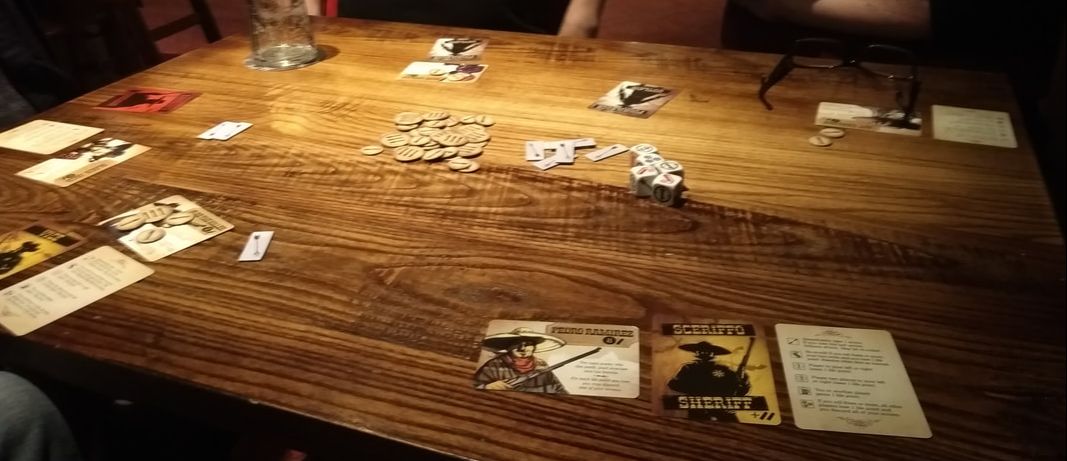
The second game of the evening was 'Bang! The Dice Game'. A hidden role game driven by push your luck mechanics. Let's see how this goes?

What's in a game?
Bang! The Dice Game comes in a small portable package. Components include:
  • Dice: 5 Custom dice used in the game.
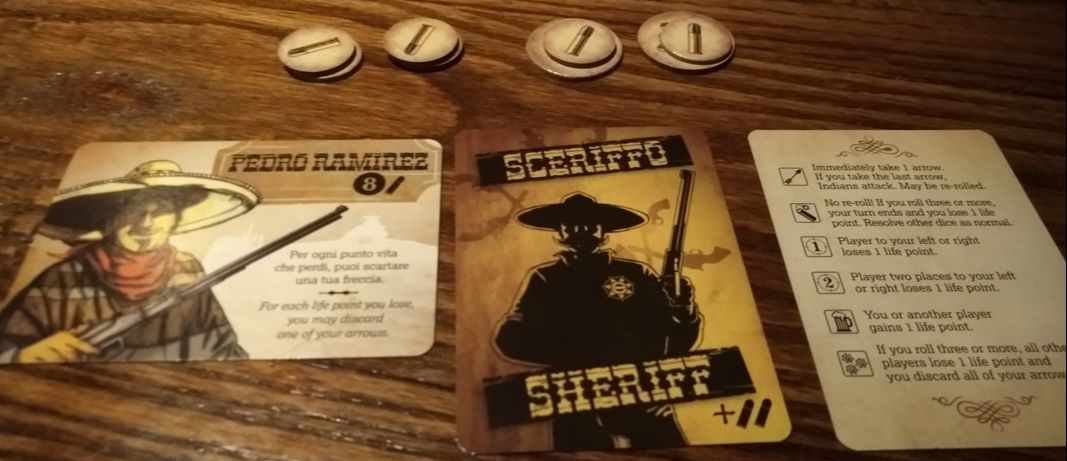
  • Character cards: Each player will be randomly dealt a character. Each character  has a unique special ability and hit points (Denominated by bullets in this game.).
  • Role cards: This wouldn't be a hidden role game if there weren't roles to hide from other players. There are 3 types of role and they are explained below.
  • Tokens: Bullet tokens represent life. Arrow tokens have another use that will be explained below.

How's it play?
First there's set up.
  • Bullet and arrow tokens are placed to form a supply in the central playing area.
  • A role card is randomly dealt to each player face-down. Whoever is the sheriff must reveal their card. All other players keep their role hidden.
  • A character card is randomly dealt to each player. These kept face up. Each player collects bullet markers equal to what is shown on their character card.

What are the hidden roles?
There are 3 types of hidden role in the game. The number of each role that appears in a game will depend on the number of players, except there is only ever 1 sheriff.
  • Sheriff/deputies (The good.).
  • Outlaws (The bad.).
  • Renegades (& the ugly.).
Each of the different roles have their own objective.
  • Sheriff/deputies: If the outlaws and renegades are defeated, then the sheriff and deputies win.
  • Outlaws: If the sheriff is defeated, all the outlaws immediately win.
  • Renegades: A little unusual here. A renegade player wins if they are the last one alive, even other renegades must be eliminated. And the outlwas must be defeated before the sheriff, if the sheriff is eliminated before the outlaws, then the outlaws win, not the renegade.

And we're good to go. Playing the game is quite straight forward.
  • The active player rolls all 5 dice.
  • The active player can choose to re-roll any or all the dice (Except for 'dynamite results - see below.).
  • The active player may also choose to have a first re-roll. This may include dice not included in the first re-roll.
  • The active player can stop rolling at any time. In which case the dice results are dealt with.
Picture
Picture
Dice and their meanings
So we now know what we do with the dice. But what do they mean. The 5 custom dice all have the same symbols on their faces instead of numbers.
  • Dynamite: Dynamite is the only die that cannot be re-rolled, if a player accumulates 3 or more of them. BOOM! Their turn is immediately over!
  • Arrow: The active play takes an arrow token from the supply and puts in on their character card. This die may be re rolled. But if the die is re-rolled, the active player still keeps the arrow they took.
  • '1': With this result, the active player can do 1 point of damage to an adjacent player.
  • '2': This is like the result above, but with a longer range. This result allows the active player to do a point of damage to a player 2 seats to the left or right.
  • Beer: This result allows the active player to heal a point of damage either to themselves or any other player.
  • Gatling gun: A single result has no effect, but if the active player has 3 of them, then they do a point of damage to all other players!

But what about the arrows?
There are 9 arrow tokens in the supply, when the last arrow has been taken by a player; then Indians Attack!
When this happens, characters immediately take damage equal to the number of arrows in their personal area. Then all the arrows are returned to the central area.

Overall
Bang! The Dice Game is a little unusual for a hidden role game. There is very little need for questioning amongst players. As is the fact that one role is revealed to all players, putting a big target on the sheriff player's back! The deputy players and possibly renegade players will need to protect the sheriff.

That's not the sheriff's only problem, the sheriff needs to figure out who is an ally and who is an enemy and not attack their deputies.
Deputies need to identify other deputies if possible (If there are other deputies). But their 2 main objectives are protect the sheriff and attack anyone attacking the sheriff.

Outlaws have it easy really, they can concentrate on attacking the sheriff. Outlaws can try a protect other outlaws, but well they're outlaws!

Renegades are in a tricky position, they want to get rid of the sheriff, but need to eliminate outlaws first.

Bang! The Dice Game is a 'lighter' hidden role game and is quick to learn and play. It serves well as a filler game.
0 Comments

Sushi Roll

27/10/2019

0 Comments

 
24th September 2019

Tuesday evening is here and we're at 'The Sovereigns' in Woking for games night.

It was an evening of several short games.
We begun with 'Sushi Roll', this game is a follow up to the rather good 'Sushi Go!'. Will Sushi Roll live up to expectations? Let's see.


What's in a game
Sushi Roll comes in a largish box and a whole bunch of components. These are solidly made and of a good quality.
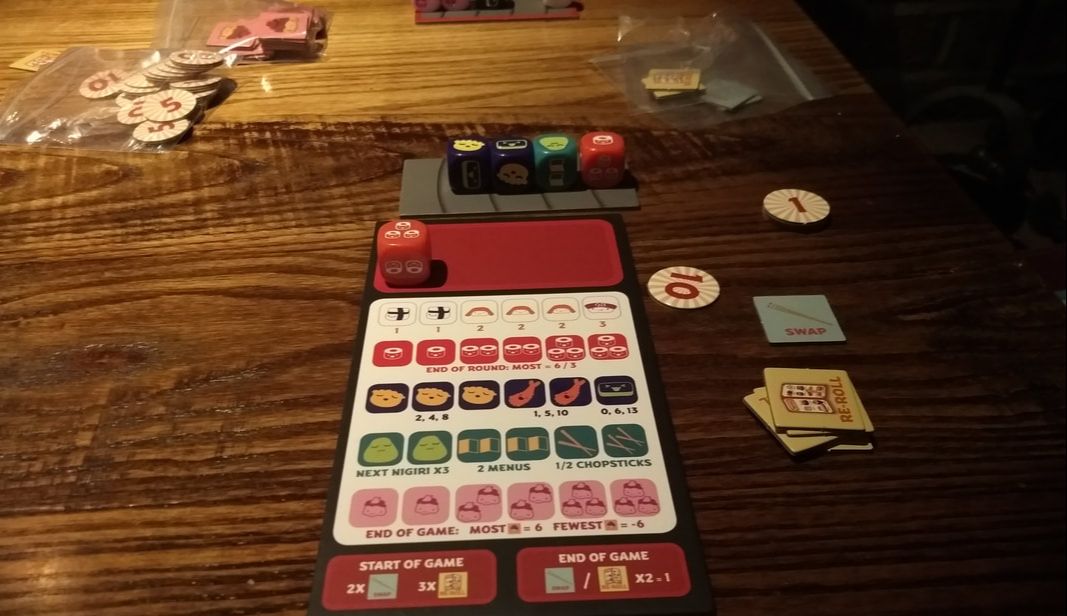
  • Dice: There are 30 custom dice. There are 5 different types of dice. Nigiri dice, maki dice, appetiser dice, pudding dice and 'specials' dice. Specials dice have symbols for wasabi, chopsticks and menus.
  • Dice bag: For the dice!
  • Conveyor belt tiles: There are 5 of these. One of them has a red outline.
  • Personal game boards: There are also 5 of these. One of them is given to each player. They basically explain the game and show the results of all the dice and how they are scored.
  • Tokens: Lots of tokens. Scoring tokens, pudding tokens, chopstick tokens and menu tokens. Lots of tokens!

How's it play?
We begin with set up:
  • Give each player a player board, 2 chopstick tokens and 3 menu tokens.
  • Shuffle the conveyor belt tiles and deal one out face-down to each player. They are then turned face-up and whoever has the tile with the red outline is first player.

Picture
And we're ready to go.
  • Each player draws dice out of the dice bag. The number of dice drawn is dependant on the number of players.
  • All players simultaneously roll their dice.
  • First player goes first!
  • Players may use tokens are a 'free action': Using a chopstick token allows a player to swap a die on their conveyor belt with a die from another player's conveyor belt. Using a menu token allows the active player to re-roll any number of dice on their conveyor belt.
  • During their turn, the active player may take one die from their conveyor belt and place it on to their personal board. If the die taken depicts menus or chopsticks, then the active player immediately takes the pertinent tokens
  • Play progresses clockwise until all players have taken a die and placed it on their personal board.
  • Now all players move their conveyor to the player to their left.
  • Players now simultaneously roll dice they have in front them and the new first player starts.
  • Play progresses until all the dice from the conveyor belts have been taken by players: The round has ended.
  • The dice on each player's personal board are all scored, except for 'pudding dice'. Players receive pudding tokens equal to their pudding dice instead.
  • All dice are returned into the dice bag, which is thoroughly shaken. Players draw dice from the bag again and a new round begins.
  •  3 rounds in total are played. After the final round final scores are tallied. Highest score wins.
Scoring is essentially identical to Sushi Go!
  • The nigiri dice have 3 different types of nigiri. Each nigiri scores 1-3 each, tripled if placed on a wasabi die.
  • The player with the highest amount of maki rolls scores 6, the 2nd highest scores 3.
  • Appetisers: There are 3 different 'sets' of appetisers. The more you collect of a particular appetiser, the more the set scores. Some sets score more but are harder to collect. Classic 'risk & reward'.
  • Puddings are only scored at the end of the 3rd round: Highest amount of puddings scores 6, lowest loses 6 points.
  • Each 2 chopstick and/or menu tokens earn a point each.
​
Overall
There's a lot to like about Sushi Roll.

There's a pleasant tactile sensation to be had when you slide or hand the conveyor belt tile over to another player.
The same is true when using chopsticks to snatch away a die from someone else's conveyor belt. The theme fits the game perfectly. 

The mechanics with the dice is very clever. You can see what dice are coming your way, but since the dice are rolled again, you don't know exactly what you're getting. It does a very good job of replacing the card mechanic from Sushi Go!. No need to try and memorise cards now!
​
Everyone I've played this game with, preferred this version to its predecessor. It's less portable and takes a little set up time, but it feels more tactile, it's a little more 'open', therefore giving players more choices to make. The scoring and pudding tokens make it a bit more 'user friendly'. Meanwhile the chopsticks and menus lend the game a bit more strategy.

​So, is it worth getting Sushi Roll if you've played Sushi Go!? In a word; yes!
0 Comments

Concept - 02

24/10/2019

0 Comments

 
22nd September 2019

Sunday afternoon, 'The Sovereigns' in Woking.

No 50 Fathoms today, so board games were the order of the day.
The final game of the afternoon was Concept.
Read my blog about it here.
0 Comments

Roll Player

24/10/2019

0 Comments

 
22nd September 2019

Sunday lunchtime at 'The Sovereigns' in Woking. Unfortunately 50 Fathoms is still on hiatus. Instead we shall play some board games.

The first board game of the day was 'Roll Player'.

Have you ever enjoyed creating characters for an RPG more than playing them? Then maybe, just maybe, Roll Player is the game for you.

Roll Player is sort of a set collecting, dice rolling, worker placement game that's all about creating what is ostensibly a D&D character.
The main of the game is that players use dice to generate their stats, but it's not a case of just rolling the dice.

What's in a game
The components for Roll Player are of a good quality. 
  • ​Dice: There's a lot of dice in Roll Player. 73 in fact, in 7 different colours.
  • Dice bag: To go with the Dice!
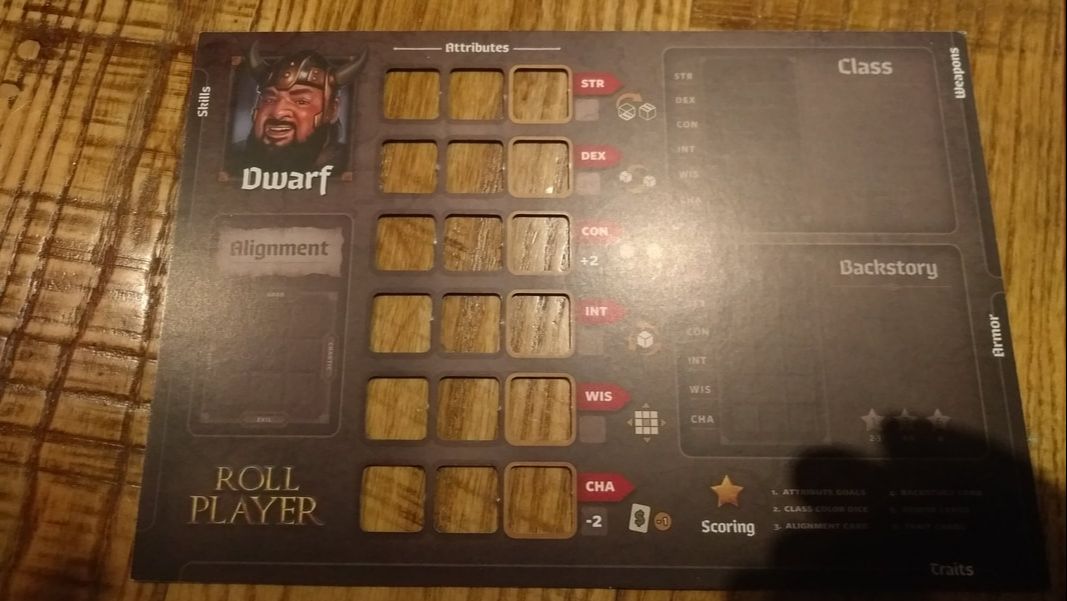
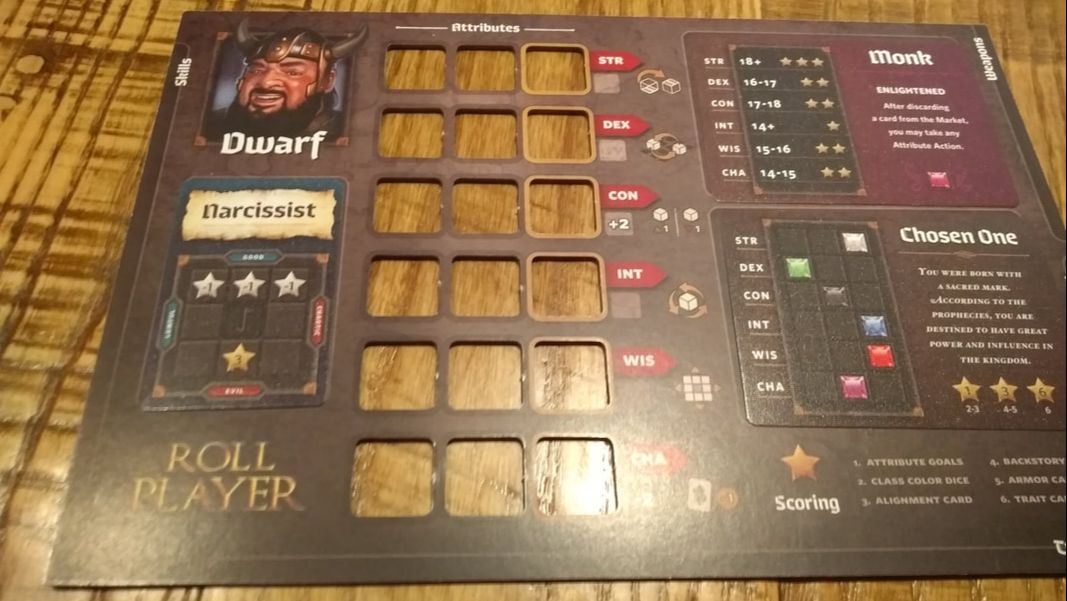
  • Character sheet boards: These are the equivalent of a character sheet. One for each of the classic D&D PC races such as human, elf, dwarf etc. Like a D&D character sheet, the player boards contain a lot of information. Such as racial stat modifiers for all 6 D&D stats (And space for 3 six sided dice for each stat!). Spaces for character class info, alignment and backstory too.
  • Character class tile: This tile goes on the relevant space on the character sheet board. These represent the classic D&D character classes. One will be randomly given out to each player. They are double sided and have 2 classes on each. Character class dictates what values your stats you need to have to score points. They will be different for each character class. Each class also has a unique special ability.
  • Alignment tile: This goes on the space for alignment and is randomly determined. Players earn points for getting their alignment to match the target on the tile. The alignment tile is a 3x3 grid that depicts all 9 alignments. A marker is used to show what the character's current alignment is.
  • Backstory tile: This is also randomly determined. It gives players an additional target to match, which in turns a player more points. This is based on the colour of dice.
  • Initiative cards: These are used to determine the order in which players buy cards from the market. They are numbered from 1 to 5.
  • Market cards: Every round, players will have the opportunity to purchase cards drawn from the market deck. Market cards include weapons, armour, skills and traits.
Picture
Dwarven character sheet board.
Picture
Character sheet board with character class, backstory and alignment tiles.
How's it play
Firstly there's set up: This is fairly straightforward.
  • In turn order, players choose a character sheet board and collect gold. Then randomly the players are dealt a character class, alignment and backstory tile.
  • Initiative cards are set out. The numbers used are equal to the number of players participating plus one. Thus if playing with 3 players, initiative cards 1-4 would be used.
  • Market cards are dealt from the deck. The number of cards dealt are equal to the number initiative cards used.
  • The dice are put into the dice bag and thoroughly shaken.
Then we can begin.
  • The active player draws a number of dice from the dice bag equal to the number of initiative cards and rolls them.
  • The active player places them on top of the initiative cards in ascending order. Thus the die with the lowest value goes on the '1' initiative card and so forth until the die with the highest value is placed on the '5' card. If 2 or more dice share the same value, the active player chooses the order in which they are placed on the initiative cards.
  • Once all the dice have been placed, in turn order. Each player takes an available die and the initiative card it was placed.
  • Then players can buy a card from the available market cards. This is not done in turn order, but in the order of the initiative cards. Thus a player who takes the highest value die will go last in the market phase.
  • Once the market phase is completed. Play moves to the next round, the initiative cards are put back in a row and new market cards are drawn. The next player clockwise becomes first player and draws dice and a new round begins.
That's the basic actions covered, but somethings need some more explanation.

Taking dice
After a player takes a die, they must place it on to their character sheet board. When doing this, there are 3 things they need to bear in mind in order to maximise their scores.
  • Stats: At the end of the game, points are scored for every stat that meets a certain criteria. This will be different for each character class, a warrior needs high strength and a magic-user needs high intelligence. Stats may have target values such as 14+, 18, 15-17 etc. These are modified by racial bonuses and penalties.
  • Colour: So each of the 6 stats has a row of 3 dice. One of the 3 dice for each stat row needs to be of a specific colour, this may be in the 1st, 2nd or 3rd spot in the row. This will use one each of 6 different colours. The final colour is yellow, yellow represents gold. Every time a yellow die is put into a stat row, the player earns 2 gold coins. At the end of the game, the more correctly placed dice there are, the more the player scores. All of this is determined by the backstory tile.
  • Special ability. Each stat row has a special ability which is triggered when a die is placed into the row. These allow the player to flip a die to it's opposite side, swap to dice round, move your alignment counter etc. These abilities are identical for all players.
When a die is placed into a row, it is always placed into the leftmost available space.

Market cards
There are several different types of card available to but from the market. When a player takes a market card, it is placed alongside the character sheet board in it's specified spot.
  • Weapons: These usually confer some sort of extra ability to whoever owns it. A character is limited to using 1 or 2 weapons at a time.
  • Armour: These cards earns the owner bonus points. Armour cards exist in sets, the more cards collected in a set, the more points scored. Like D&D, only certain character classes can use certain types of armour.
  • Skills: When a player acquires a skill card, they can use its special ability, this also moves the characters alignment marker. A player may use multiple skill cards at a time and even in another player's turn. When a skill is used it is turned sideways. One card may be returned to the upright position per round.
  • Traits. When a trait is acquired, it moves the character's alignment marker. Each trait card also gives its owner an extra objective to complete. Each objective completed successfully earns points.
If a player does not or cannot purchase a market card, they must discard one market can and receives 2 gold coins.
A new row of market cards is dealt every round.

Endgame
Play continues for 18 rounds until all 6 stats have 3 dice. Points can earned from several sources, these include:
  • Stat values.
  • Backstory.
  • Alignment.
  • Armour set.
  • Traits.
  • Class colour dice: Each character class is associated with a certain colour. Each die in a character's stats of that colour earns the player an extra point.
Then points are tallied. highest score wins.

Overall
Roll Player is a game with an intriguing theme. Because placing a die has so many consequences, play slows down quite a lot when both choosing and placing a die, so there feels like there is a lot of downtime between turns.

Apart from this, the game fine to play and when you complete Roll Player you will have an interesting character.
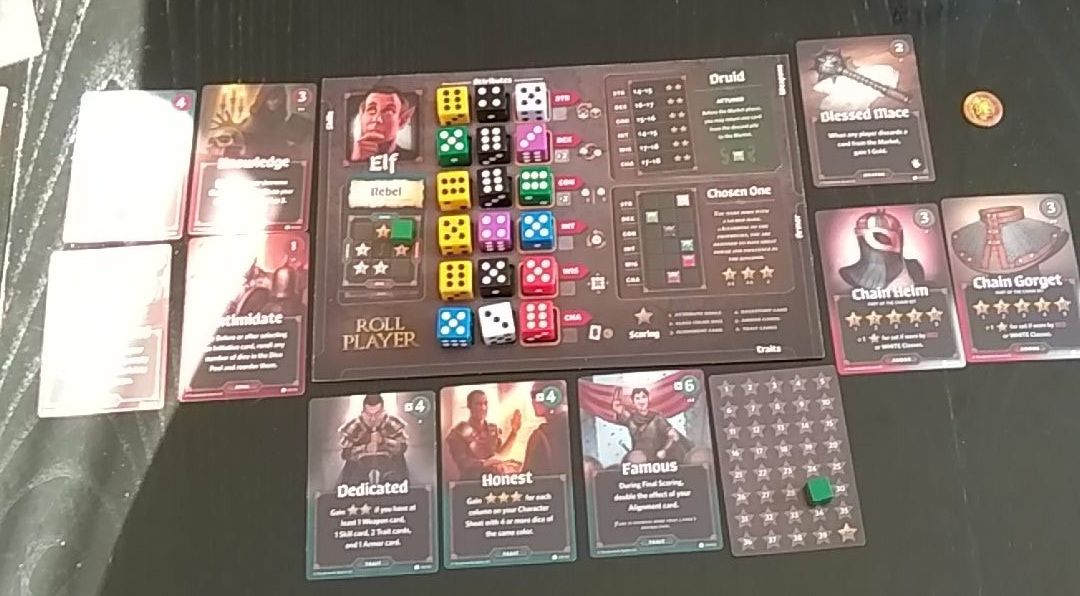
Picture
Completed character sheet.
My first Roll Player character was: 'A concentrating, knowledgeable, intimidating, dedicated, honest, famous, chain-armour-wearing, blessed-mace-wielding, druidic, elven chosen one who's good at sleight of hand. His name is Derek!'
0 Comments

Machi Koro Legacy - Games 1-5

20/10/2019

1 Comment

 
21st September 2019.

It's Saturday evening round at Matakishi's and that can only mean games night!

​So here we have 'Machi Koro Legacy​'. As the title suggests, this is a legacy version of the very good Machi Koro game.
Spoilers!!!
Don't read any further ahead if you want to play Machi Koro Legacy!

What's a legacy game?
Glad you asked. A legacy game's unique feature is that it is actually a series of play-throughs of the same game. After each game concludes, something changes, is added or removed from the game and that change carries over to the next play-through of the game. Thus you have (In theory.) a game that constantly changes and evolves according to player input.

Machi Koro Legacy is played over 10 games. We played games 1-5 in one night and in total all 10 games were played over 3 evenings.
I'm going to blog about all of the games in this post. Since at the time of writing, these blog posts are about a month behind the actual plays.

If​ you don't know anything about Machi Koro, you can read my blog about it here.
Have you read it?  Good! Now you know all about Machi Koro.

The Basics
The original Machi Koro has 2 expansions, 'The Harbour' and 'Millionaire's Row'.
Generally we play Machi Koro with The Harbour.
​As you would expect, the core mechanics of Machi Koro remain unchanged for the 'legacy' version.

If you didn't actually bother reading my blog about the main game: Here's a quick recap.
  • The objective of the game is to purchase all the landmarks first. This is done with money.
  • Money is accumulated by building up your city and profiting from this.
  • In game terms, building up your city is done by purchasing 'establishment' cards from the available choice of cards in the main game area, called the 'market'. These cards are all numbered from 1-12.
  • At the start of the active player's turn, they roll 1 or 2 six sided dice. Every card in the active player's city that has a matching number will then probably earn them money.
  • Now the player can spend any money they have.
  • There's bit more to it, but that's enough to be getting on with.

The legacy game
I can't really blog about the game in my normal format because the components and rules change throughout the game. So I'll just go through it as best as I can. I'm not going to extensively talk about the original, I'll try to just talk about any differences between 'original' and 'legacy' versions.​

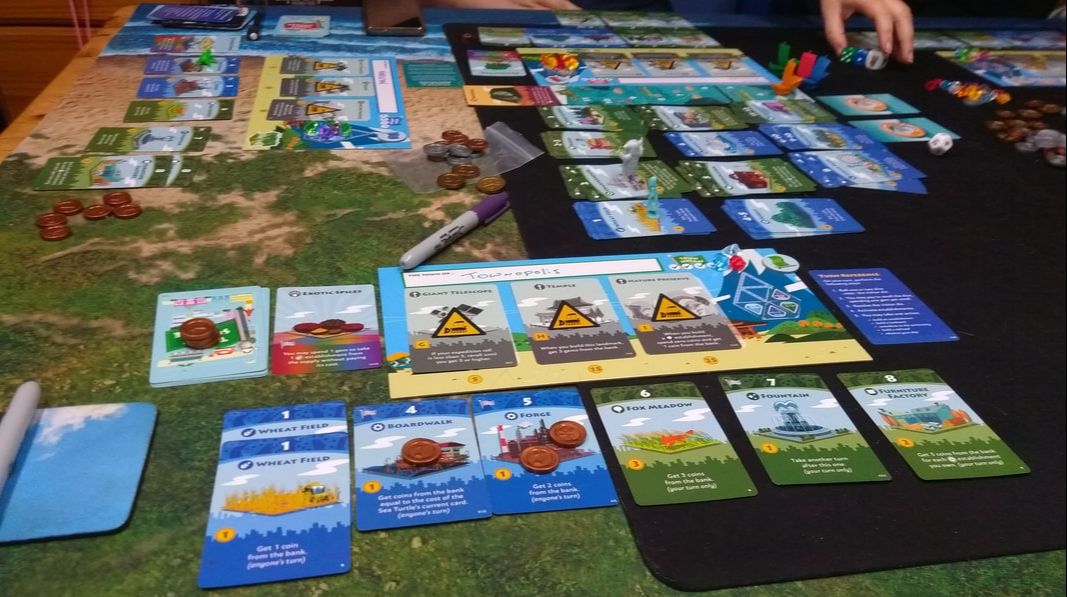
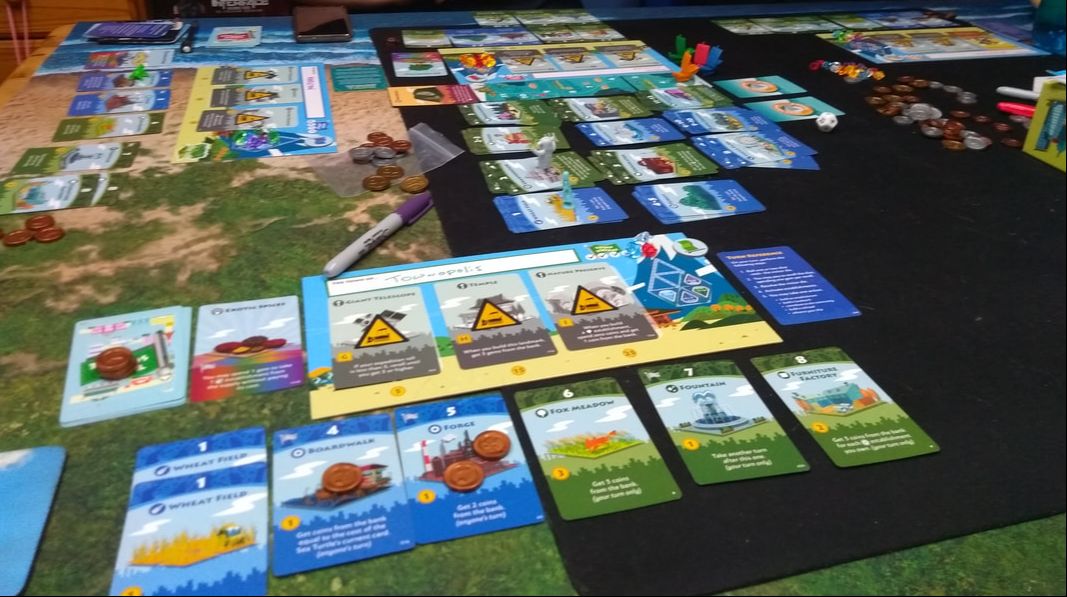
Personal game board
This is immediately different. In legacy, each player is given a game board that has the following:
  • Space for your settlement's name: Thus the tiny village of Townopolis was born.
  • 4 tick boxes. 2 of these tick boxes are immediately ticked. These determine how many cards a player will will start the game with. In original, players start with the same 2 cards, a Wheat Field and a Bakery. But in legacy, each player is given a number of cards (Called Town Square cards.) from which they choose their starting cards. Initially players start with 2 cards, but as the boxes are ticked, they will start with 3 then 4 Town Square cards.
  • A row of 3 spots for cards, with '5', '15' & '25' beneath them. These spaces are for landmark cards, which are put out at the start of a game. As each game is completed, the card on the '5' space is discarded and the other 2 landmark cards slide 1 space to the left into the cheaper spaces. A new landmark is then placed into the '25' space. There's also a 'communal' landmark card that is placed in the main playing area, this landmark is changed for every game. To win a game, players must buy all 4 landmarks. This is a bit different from original,.
  • Triangular grid: On the right side of the board is a triangular grid. Players may spend actions 'filling' a triangle instead of buying cards. Filling in a triangle normally takes 2 or 3 actions. Triangles that are 'filled in' earn the player another new thing to the game - diamonds. What are diamonds (See below.)?
Diamonds
Diamonds are a new currency introduced in Legacy. Players can start a game with diamonds or acquire them during play. Some landmarks and cards can use diamonds for a benefit. But the main use of diamonds is to spend them to re-roll dice rolls.
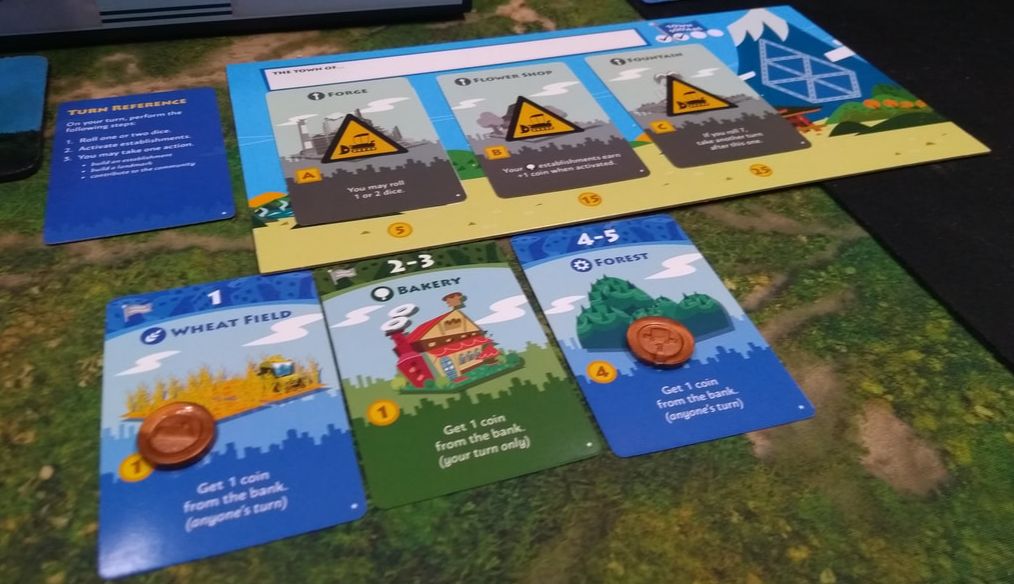
Picture
Double sided establishment cards
These are an entirely new type of game introduced in Legacy.
When a game is concluded, a new type of card is added to the market from the next game onward. These cards are 'double sided'. One side tends to be blue/green and the other red or occasionally purple. The player who just won the concluding game gets to choose which side is used, these cards have tick boxes which can ticked to indicate which side was initially chosen.

During later games, it is possible that a stack of double sided cards can be flipped over to their other side. If this occurs, then it also affects all copies of that card in players' areas! (See below for how 'flipping' can occur.)

Traveller die
Another new introduction to legacy is the 'traveller die', a blank six sided die. What's the point of a blank die you may ask? Well, it doesn't stay blank for long. As games are completed, stickers are added to die. The traveller die is now rolled along with the normal dice. The following stickers are added to the traveller die: Turtle, yokai and moon princess
There 3 travellers each have their own little figure that moves along cards as dictated by the rules for the traveller die.
  • Turtle: 2 turtle stickers are added to the traveller die. The turtle travels along the player's establishment cards. When the turtle result comes up on the traveller die, the turtle will move along player cards a number of times equal to the result on the normal dice roll. When the turtle stops on a card, it's owner is given money equal to the card's cost. The turtle always starts the game on a card belonging to the player who has won the least number of games.
  • Yokai: When the yokai appears, 2 more stickers are added to the traveller die. Generally the yokai is 'mischievous', but in the end becomes a 'nice guy'. The yokai always starts on the fishing boat card stack in the market area and moves along card stacks in the market area. When a yokai result comes up, the yokai moves along a number of card stacks in the market area equal to the dice roll. When the yokai stops on a 'double sided' card, then that card is flipped to its other side. Additionally, any card the Yokai is currently standing, cannot be bought by any player. Eventually the yokai learns the error of his ways and becomes 'nice'. This means that when he stops on a card he no longer flips or blocks it and players are given money from the bank if they have that type of card in their personal play area.
  • Moon Princess: When the moon princess appears, 2 final stickers are added to the last 2 blank spaces on the traveller die. The moon princess starts the game on the wheat field card stack in the market area. Like the yokai, the moon princess moves along card stacks in the market area. When the moon princess is standing on a card stack, then the active player can buy a card from that stack for free.

The sea
Another new addition to legacy that appears later in the game is 'the sea'. This is depicted by placing 3 cards in a column in the market area along side the establishment cards. Then, each player receives a boat figurine in their colour and a 12 sided die is introduced into the game. What does this all do? Well, read on:
  • Sea travel: The 3 cards used to depict the sea have 10 locations on them, each location is also numbered from 3 to 11.
  • If players want to travel the sea, they put their boat at the bottom and travel upwards, starting at 3 and ending at 11. It uses their action for their turn to do so. There are 2 modes of transport available to them. Sailing and rowing.
  • Sailing: In order to sail further, the active player must roll the 12 sided die and get a result higher than the number on the next spot that they are headed to. Thus it is possible to fail sailing. Failure can also see the ship go backwards.
  • Rowing: To move forward by rowing, the active player simple spends money equal to the number on next spot they are headed for. It costs, but there's no chance of failure.
  • Some of the later spots give the players who reach them bonuses such as a free card from the main playing area, cash, an extra go, Etc.
  • In the game that the sea appears, the communal landmark requires a player reach the final spot on the sea before they can buy the communal landmark.

Islands
When the sea has been introduced, islands are next. Islands work in the following way.
  • 5 island cards are placed face-down in a row in the playing area.
  • Each island corresponds to spots 6-10 on the sea track.
  • When a player's boat reaches a relevant spot they can look at the corresponding face-down card. They do not reveal it to other players and put it back still face-down.
  • Once the player has looked at a face-down island card, they can decline from taking it or choose to take it. If they do take it, then they return back to the start of the sea track.
  • If a player takes an island card, it cannot be used immediately. It can be used from the start of the next game onward. It is permanently added to a player selection of cards.
  • When a player starts a game with a island card in their possession, they can use it as a town square card, therefore it counts against their town square card limit.
  • Even though an island card counts as a town square card, it is not considered a normal card. It cannot be activated by a dice roll, nor does the turtle travel on to it.
  • Island cards work by allowing the active player to spend diamonds to acquire cards of a particular type as a free action before they roll the dice. The type of card they can buy is dictated by the island card. Thus a player can get 2 establishment a turn or a establishment and a landmark etc.
The moon
During one of the latter games, the players will acquire rockets for their ships and in the 10th and final game, they will travel to the moon in an endeavour to return the moon princess home.
  • The moon card is added to the top of the sea track to form a new track - I guess the moon track?
  • Journeying to the moon is identical to journeying in the sea (If only it was so in real life!) except the moon card adds an extra 3 spots to journey along
  • None of these spots can be reached with a roll of the 12 sided die. Players must spend money to reach the moon (Space programs are expensive!).
  • The final communal landmark require a player reach the moon in order to buy it.

Right that's about it for what's in the game and rules. I've missed out some bits about some cards being removed from play and so on, but that I think is most of it.

The 11th game
Once the 10th game has concluded. The remaining cards can be used to make up a new game of Machi Koro. Having a functioning game afterwards is a nice touch.
Picture
Picture
Overall
I think this blog post I've written about Machi Koro Legacy is going to be the longest blog I've written about a card game so far. I guess a legacy game can complicate things quite a lot and there's quite a lot to process here.

Additionally, I will state that this is the only legacy game I've ever played and I have nothing to compare it to or measure it against. I guess I'll just go through the things listed above and blog my thoughts about them.

Town square cards
I actually quite like this idea, it gives players a meaningful decision to make immediately and can lead to an asymmetrical game start (See below for more on this.).

Landmarks
As your small fishing settlement advances through civilisation to fulfil its destiny of becoming a 'space power', it's only natural that its landmarks will change over time.
So thematically I understand it, but from a game play perspective, I'm ambivalent towards it.
This is partially I think, because I didn't find them particularly interesting or useful. Especially since there's so many of them (10 communal and 12 player landmarks.) and they only hang around for a maximum of 3 games.

Diamonds
Diamonds have several uses in legacy.
Some landmarks allow players to use diamonds for extra turns or for extra cash. They can also be used in conjunction with island cards to acquire establishment cards.
But probably the biggest use of diamonds is for re-rolls.

The original Machi Koro gave players a re-roll once per turn in the form of a landmark that they could purchase.
Legacy take this a step further by giving players the ability to spend multiple diamonds to gain multiple re-rolls.

This has a low impact in the early games, but a high impact in the later games. When a players has 8 diamonds, they spend a long time pondering their many potential re-rolls. 
I don't actually mind the game slowing down that much (I'm used to it.).
​I dislike how easy it is to just mitigate so many bad rolls. Having to deal with bad rolls is part of what makes Machi Koro what it is.


Double sided establishments
The idea of having dual-function establishments seems like a reasonable idea. It can change up the dynamic of the game a little and doesn't seem to have a negative impact. If only there was a better way to implement them other than the yokai (See Below.).

Travellers
Legacy adds 3 travellers to the game, as well as an extra die and extra rule to deal with it all. The problem I have with this is that all it does is introduce an extra random element and no game play element. When travellers do move, most of the time it has minimal or no impact on me or the decisions I made.
  • Turtle: The turtle moves about 1 in 3 turns, so someone will benefit from the turtle 1/3 of the time. It probably takes at least 5 turns for a turtle to come back around to a player again. This means an individual player benefits from the turtle about every 20 turns and will mostly gain a small amount of coins. Not very exciting is it.
  • Yokai: Until the very last couple of games, all the yokai does is randomly frustrate players. To be fair, I think there was only one occasion when the yokai stopped me getting a card I wanted. Even so, not good in my opinion.
  • Moon Princess: So the moon princess allows players to purchase a card that she has stopped on for free. Unfortunately, it's not as good as it sounds, unless the moon princess has landed on a card you want at that time, you'll be faced with a choice. Get a free card that you might not need or want? Or pay for the card you want? When faced with that choice, I always chose the latter. A useless card that's free is still useless. Not once did I benefit in any of the legacy games I played which involved the moon princess.
I don't dislike the travellers, they just feel a bit pointless.

The sea
When the sea was added into legacy, it introduced a fiddly and slightly confusing set of mechanics to the game. Not only that, they're completely alien to Machi Koro's 'style' and lack any elegance. You might as well have added a copy of 'Monopoly' to legacy, they're so different.

Furthermore, when the sea was added to legacy was when the game started to really slow down. All those extra little rules and extras just dragged it down. It seems that the combination of the sea and diamonds is not a good one.

Island cards
The island cards are quite an interesting proposition.
  • The bad: Island cards allow players to acquire certain establishment cards for diamonds in addition to buying one normally. This essentially allows the player double the cards they acquire for their first few turns. During the games we played, I acquired the island card that allowed me to use diamonds to purchase establishments with the 'wheat' symbol. After this, concentrating on wheat establishments and the cards they 'feed' into was a 'no-brainer'. And the problem with no-brainer strategies is that they're as meaningless as a meaningless choice - because they're a no-brainer. Essentially, the island card dictated my strategy (If I put in my starting cards - which I did.).
  • The good: I like the idea of having single unique cards in the game. I like the idea of having single unique town square cards. I'm sure there would a way of implementing this without all the associated unnecessary stuff.
The moon
The moon track is essentially an extension of the the sea track. Everything I've said about the sea, applies equally here.

So that's it. As I explained earlier, this is the only legacy style game I've played. And to be honest, in regards to Machi Koro, I don't think it adds much to the experience of playing it.

Sure, it adds some interesting ideas to the mix and it was nice seeing new cards. But it also adds a whole lot of unnecessary stuff too. Additionally, the changes that occur throughout the games feel very small, the choice that the winner makes after every game feels inconsequential.

I don't regret playing Machi Koro Legacy at all; it provided us with 10 games and 3 evenings of entertainment. But during those games I never felt that I was playing something superior to the original. 
1 Comment

WFRP - Session 07

20/10/2019

0 Comments

 
19th September 2019

It's a Thursday and this now means it time for WFRP, our playing day has changed.

'The Enemy Within​' campaign continues.

Our brave adventurers are still in Altdorf and investigating the death of the Grand Theonogist.
During the last session, the party realised most of their leads have met with suspicious and nasty ends. 
They only have 1 living lead left: An agitator called 'Mayer Gauss'. The party have discovered that he as an associate of the deceased 'Batrek Steelfist'.
They also know that Mayer tends to appear at the speaker's corner close to the university district every week or so. 

Over the next few days they visit speaker's corner frequently without success. They also investigate all the local pubs and drinking establishments. Mayer is recognised, but no one has firm details about him.
Finally, party investigate some colleges to see if Mayer was a former student, but he was not an alumni at any of the colleges they visited.

Then on one morning, the party are leaving their townhouse and their is a buzz on the streets. After a bit of chatting, the party discover that a rumour is circulating the city: The assassins have been caught!
0 Comments

Noctiluca - 04

20/10/2019

0 Comments

 
17th September 2019

Gaming Tuesday at 'The Sovereigns' in Woking continues.

Our 2nd and final game of the night was 'Noctiluca'.
You can read my post about it here​.
0 Comments

Cloud 9 - 02

20/10/2019

0 Comments

 
17th September 2019

Tuesday has come back around and we're at 'The Sovereigns' in Woking.

We began the evening with 'Cloud 9'.
You can read my blog about it here.
0 Comments
<<Previous
Forward>>

    Author

    I play, I paint.
    ​This is where I talk about what I play.

    Archives

    March 2025
    March 2024
    June 2023
    May 2023
    April 2023
    March 2023
    February 2023
    January 2023
    December 2022
    November 2022
    October 2022
    September 2022
    August 2022
    July 2022
    June 2022
    May 2022
    April 2022
    March 2022
    February 2022
    January 2022
    December 2021
    November 2021
    October 2021
    September 2021
    August 2021
    July 2021
    June 2021
    May 2021
    April 2021
    March 2021
    February 2021
    January 2021
    December 2020
    November 2020
    October 2020
    September 2020
    August 2020
    July 2020
    June 2020
    May 2020
    April 2020
    March 2020
    February 2020
    January 2020
    December 2019
    November 2019
    October 2019
    September 2019
    August 2019
    July 2019
    June 2019
    May 2019
    April 2019
    March 2019
    February 2019
    January 2019

    Categories

    All
    2 Player Only
    50 Fathoms
    Abstract
    Annual Quiz
    Area Control
    Asymmetrical Play
    Auctioning
    Bidding/gambling
    Black Hack
    Bluffing
    Board Game
    Campaign Play
    Card Game
    Clockwork & Chivalry
    Cooperative
    Cthulhu Hack
    Deck/Bag Builder
    Deduction
    Dice Game
    Drafting
    Engine Builder
    Hand Management
    Hidden Movement
    Hidden Role
    In Darkest Warrens
    Legacy
    Memory
    Merry Outlaws
    One Vs Many
    Oubliette
    Party Game
    Programming
    Push Your Luck
    Real Time
    Renaissance
    Resource Management
    Roll And Move
    Roll And Write
    Route Builder
    RPG
    Sand Box
    Savage Worlds
    Set Collecting
    Storytelling
    Tableau Builder
    Team Based
    The Month In Gaming
    The Year In Gaming
    Tile Placement
    Trading
    Traitor
    Trick Taking
    Voting
    Wargame
    Wasted Hack
    WFRP
    Wogglecon
    Word Game
    Worker Placement

    RSS Feed

Powered by Create your own unique website with customizable templates.
  • Home
  • Special Effect
    • Special Effect
    • The Final Return of The Indiana Jones Charity Globe Trot
    • The Warlock of Firetop Mountain Challenge
    • Return of The Indiana Jones Charity Globe Trot
    • Bard's Tale Challenge
    • Fighting Fantasy Challenge
    • The Indiana Jones Charity Globe Trot
    • Mirkwood Charity Walk
    • Middle-earth Charity Walk
    • Dungeon Daze
  • RPGs
    • The One Ring
    • The Evils of Illmire
    • Beach Patrol
    • The Surrendered Lands
  • Game Blogs
    • RPG Blog
    • Gaming Blog
  • Painting Blog
  • Contact